Researchers at Xcimer Energy and universities remove major bottleneck for commercializing laser fusion energy
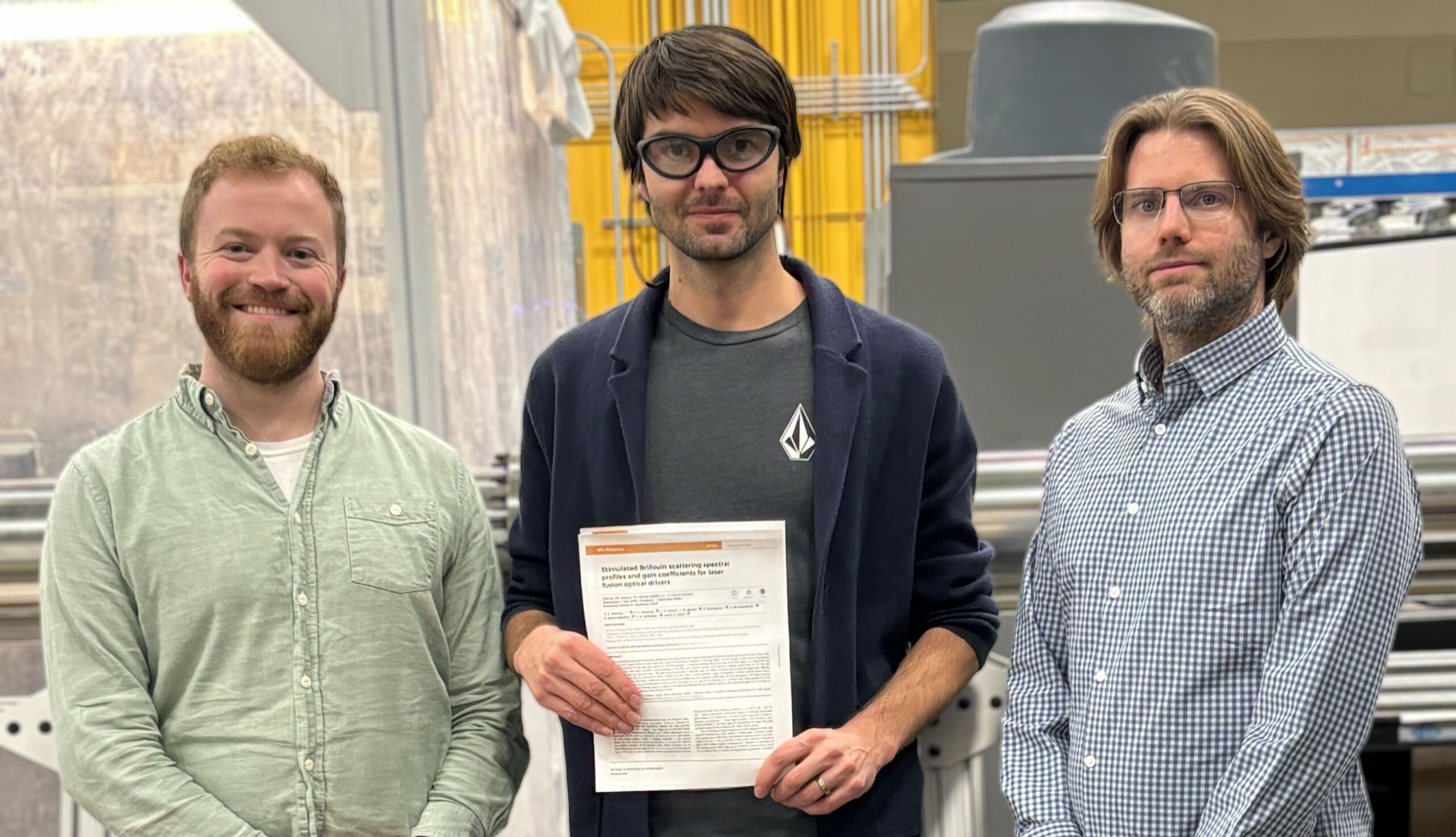
- New peer-reviewed measurements overturn decades-old assumptions and enable a next-generation fusion laser design
- Researchers at Xcimer, University of Illinois and University of Alberta demonstrated high-resolution, absolute measurements that confirm textbook models omit key behavior
- The breakthrough on Stimulated Brillouin Scattering confirms a key feature of Xcimer’s laser fusion architecture, which is more than an order of magnitude lower cost and can scale to much higher energy than conventional solid-state laser approaches
Denver, CO (Feb. 3, 2026) — A newly published collaboration between Xcimer Energy and university researchers has overturned half a century of assumptions in nonlinear optical physics, confirming that Xcimer can remove a major bottleneck to the commercialization of laser fusion energy.
In a peer-reviewed paper published in APL Photonics, researchers from Xcimer Energy, the University of Illinois, and the University of Alberta reported the first absolute, high-resolution measurements of Stimulated Brillouin Scattering (SBS) gain and spectral structure in low-pressure noble gases.
The results confirm that a core process which can be used to shorten high-energy laser pulses behaves fundamentally differently than described in standard models, with direct implications for the design and scale-up of fusion laser systems.
Laser fusion depends on generating enormous amounts of laser energy and delivering it in nanosecond-scale, precisely shaped pulses. One of the few techniques for achieving this involves generation of microsecond-scale, high-energy pulses from low-cost excimer lasers, and then compressing that energy in time by transferring it to low-energy nanosecond-scale pulses via a nonlinear optical process called Stimulated Brillouin Scattering (SBS).
The SBS process is the mechanism by which the low-energy short pulses interact with the high-energy long pulses in a gas medium, with the result that the short pulses amplify and take the energy away from the long pulses, effectively compressing energy in time.
SBS-based pulse compression had been pursued in the 1970s and 1980s at institutions including Los Alamos National Laboratory and the UK’s Rutherford Appleton Laboratory, but it was thought that this pulse compression process would require high-pressure gas cells with energy fluences limited by windows and filamentation in the gas, and the approach was abandoned as impractical.
The new measurements show that SBS in atmospheric pressure gases are governed by kinetic, rather than hydrodynamic, physics, yielding interaction strengths over an order of magnitude larger than predicted by widely used theory. This allows windowless, efficient, high fluence compression of laser energy vastly reducing the number of delicate physical optics required in a beamline and bypassing optics damage challenges which plague conventional solid-state laser approaches.
Overlooked no longer
These results resolve questions lingering since the 1970s, when scientists explored SBS-based pulse compression at institutions including Los Alamos National Laboratory and the UK’s Rutherford Appleton Laboratory. The scientists ultimately abandoned the approach as impractical, based on simplified models that only capture hydrodynamic effects.
Notably, a 1975 paper published in the Soviet Union predicted that SBS gain under specific conditions would be approximately 13 times stronger than conventional estimates. The laser fusion community never experimentally tested and largely overlooked that prediction. The new measurements directly confirm it, providing experimental “ground truth” for how SBS actually behaves at low pressures in gases.
“Our data show that the physics encoded in standard SBS models—and in most textbooks for the past half-century—is incorrect for low-pressure noble gases,” said Conner Galloway, CEO and co-founder of Xcimer Energy and a co-author of the study. “We’ve proven that the kinetic model governs the SBS process in this regime and enables an architecture for commercially viable, mulit-megajoule-class laser systems.”
Xcimer funded the experiments, which were conducted at the University of Illinois Urbana-Champaign.
Order-of-magnitude improvements
The researchers set out to experimentally confirm that SBS at low pressure (around one atmosphere) is governed by kinetic—not hydrodynamic—physics. The kinetic model predicts order-of-magnitude larger fundamental coefficients, enabling the low-cost, efficient pulse-compression architecture used by Xcimer.
Xcimer’s fusion power-plant design relies on generating long, microsecond-scale laser pulses using a low-cost excimer laser system, then compressing those pulses by approximately 1,000× using SBS in low-pressure noble gases.
“This paper demonstrates that Xcimer’s architecture is viable from an SBS physics perspective,” said co-author Dr. Andrey Mironov, who led the experiment as a research professor at UIUC, where Prof. J. Gary Eden directed the laboratory. “It supports our theoretical modeling and gives us confidence in designing the next generation of lasers.”
“Our 60,000-square foot prototype laser system, which we’ve nearly completed in Denver, will demonstrate SBS pulse compression at a much larger scale, with laser pulse energies roughly 10,000 times higher,” added Mironov, now Xcimer’s Director of Experimental Science.
This SBS result enables an inertial fusion laser built with gas optics utilizing the SBS to reflect and focus light without a material surface like a lens or a mirror. Conventional inertial fusion laser systems, like the National Ignition Facility at Lawrence Livermore National Laboratory, are constrained by limits on laser damage to material optics, and are extremely expensive because of the volume of material optics required.
The high cost of conventional laser systems limits the amount of laser energy available, thus limiting the mass of fusion fuel that can be burnt and the amount of energy that can be produced. By eliminating most of the expensive optics, an affordable higher-energy laser can be built, enabling commercially viable economics from laser fusion for the first time.
Fusion’s road to commercialization
In 2022, Conner Galloway and Alexander Valys co-founded Xcimer Energy to accelerate America’s lead in laser fusion and scale it from national labs to commercial energy production.
The company combines the only fusion approach that has been experimentally demonstrated to exceed scientific breakeven (hotspot-ignited laser-inertial fusion) with a novel laser architecture that has significantly lower costs than solid-state laser technology such as that used at the NIF.
In 2025, Xcimer completed the first key component of its prototype laser system. In December, the company began testing the highest-energy KrF laser built in the 21st century. This laser is a key part of the Phoenix system and provides the optical energy to drive the pulse-compression prototype. The prototype will test SBS physics in a regime that is scalable to the conditions required for MJ-class compressors used to ignite inertial fusion fuel capsules.
Xcimer’s Phoenix system is on budget and on schedule to be fully complete in the first half of 2026. Xcimer’s goal for 2030 is to complete the construction of Vulcan, its next-generation facility, which will achieve the highest laser energy in the world, up to 12 MJ, using the largest laser amplifiers ever built.
Xcimer expects to select a site for Vulcan this year. In 2031, Vulcan is expected to achieve engineering breakeven from fusion for the first time. Xcimer’s laser will be the world’s brightest, highest-energy and most powerful laser system.
About Xcimer Energy Inc.
Xcimer combines novel laser technology with proven science to commercialize laser fusion energy. Founded in 2022 and based in Denver, Colorado, Xcimer is backed by the world’s leading climate tech investors and has been selected for funding by the U.S. Department of Energy. Its mission is to develop a source of unlimited, clean, safe and reliable energy to power the future. To learn more, visit https://xcimer.energy/.
Contact Xcimer media relations team:
media@xcimer.energy