
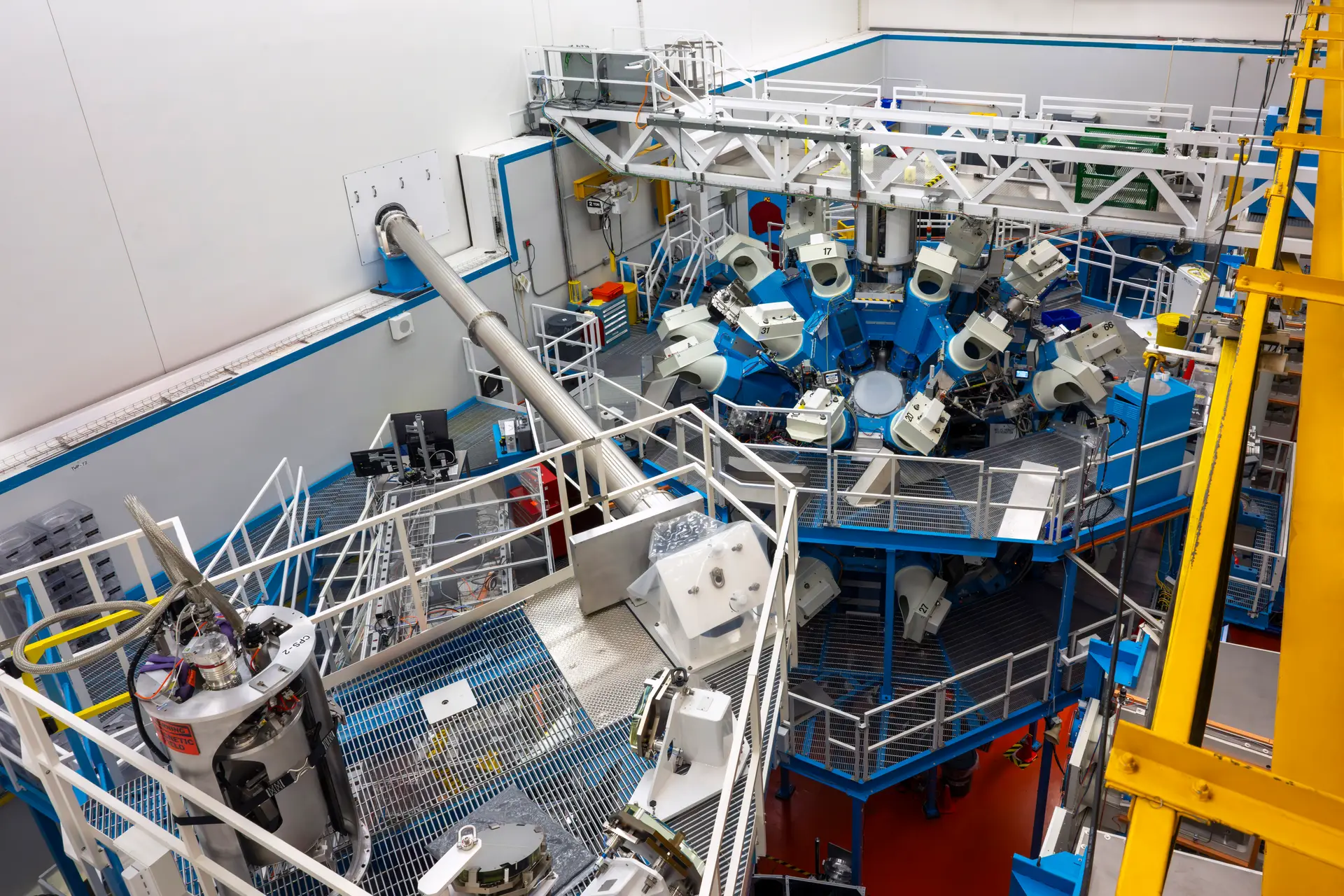
The OMEGA Target Bay, courtesy of the Laboratory for Laser Energetics / photo by Jake Deats
- New data on hybrid hohlraums supports modeling, diagnostics, and path to scalable laser fusion systems
- The experiment is the latest in a growing body of Xcimer research that significantly derisks Xcimer’s approach to laser fusion – the only viable path to commercialize the only fusion approach that’s been scientifically validated to achieve net energy gain
DENVER, CO — MARCH 18, 2026 — Xcimer Energy today announced that it completed experimental shots at the University of Rochester’s Laboratory for Laser Energetics, accelerating the company’s goal of commercializing laser fusion.
Scientists and engineers from Xcimer and partnering institutions conducted an experiment at the OMEGA Laser Facility as part of a National Laser Users’ Facility campaign. The experiment focused on externally driven halfraums (half-hohlraums) as part of early validation of Xcimer’s two-beam approach to inertial fusion energy.
Scientists and engineers from Xcimer and partnering institutions conducted an experiment last month at the OMEGA Laser Facility as part of a National Laser Users’ Facility (NLUF) campaign. NLUF is a merit-based user program supported by the Department of Energy National Nuclear Security Administration, providing academic and industrial scientists and students with access to the world-class Omega Laser Facility for basic research.
The experiment focused on externally driven halfraums (half-hohlraums) as part of early validation of Xcimer’s two-beam approach to inertial fusion energy.
OMEGA cannot replicate Xcimer’s full target–laser architecture, as the facility does not support the beam shaping capabilities or F-numbers required for the final design. Instead, beams were intentionally repointed onto the outer baffles of a halfraum configuration to mimic the laser–target coupling conditions Xcimer is actively designing and modeling.
Copper, gold, and lead halfraums were tested, with measurements of radiation temperature and shock velocity used to constrain the radiation-hydrodynamics models that inform Xcimer’s halfraum designs.
“The goal of this campaign was to generate experimental data that directly informs our hohlraum design work,” said Alison Christopherson, Head of Target Design at Xcimer. “This data provides the validation required for system-level confidence as we scale from individual experiments toward an integrated fusion energy system.”
Crucial benchmark for modeling
The data will be shared with partner institutions developing target designs for Xcimer’s fusion approach and will serve as an early benchmark for the company’s internal modeling efforts. Validated models are essential for designing targets, chambers, and laser configurations capable of supporting a commercial fusion pilot plant.
The halfraums for this campaign were fabricated by General Atomics, Xcimer’s collaborator on target factory design for the Fusion Pilot Plant. The work was conducted in collaboration with the Laboratory for Laser Energetics, Los Alamos National Laboratory, and the Polytechnical University of Madrid.
These OMEGA experiments directly support the risk-retirement pathway in Xcimer’s Fusion Pilot Plant (FPP) roadmap by strengthening the physics basis for plant-scale target performance. The roadmap progresses through three dedicated facilities:
- Phoenix, which is nearly complete, will derisk key gas-optics elements of Xcimer’s laser architecture and validate beam shaping at high fluence.
- Anvil, a two-sided 200 kJ target-shooter using full-scale laser hardware to demonstrate integrated laser performance and validate laser–target coupling with only two shaped beams.
- Vulcan, a 12 MJ-class facility aimed at demonstrating wall plug breakeven and closing the remaining plasma performance gaps required for the FPP.
“Disciplined experimental validation”
In parallel, key leaders, scientists, and engineers from Xcimer’s Denver-based team participated in the experiment. The team engaged directly with OMEGA facility operators, gaining firsthand exposure to facility operations and shot execution to inform future scaling, operability, and system integration for Anvil and Vulcan.
The OMEGA Laser Facility is operated by the Laboratory for Laser Energetics (LLE) at the University of Rochester – one of the world’s premier high-energy-density science facilities. Designed to advance research in inertial confinement fusion, plasma physics, and astrophysics, LLE plays a critical role in supporting the National Nuclear Security Administration’s mission for stockpile stewardship and scientific discovery.
Laser-driven inertial fusion remains the only fusion approach to have achieved scientific breakeven in the laboratory. Xcimer’s strategy focuses on translating that scientific milestone into a repeatable, economically viable energy system by simplifying driver architecture and rigorously validating performance at each step.
“These shots represent the kind of disciplined experimental validation required to turn laser fusion into an engineered energy system,” said Conner Galloway, co-founder and CEO of Xcimer Energy. “Laser fusion is the only approach that has demonstrated scientific breakeven. The question now is whether it can be engineered into something scalable and reliable. Every dataset like this helps derisk that path—by grounding our models in experiment, tightening our designs, and showing that the physics holds as we move toward practical systems.”
Fusion’s road to commercialization
Laser-driven inertial fusion was pioneered at U.S. national laboratories, including Lawrence Livermore National Laboratory, Los Alamos National Laboratory, and the Laboratory for Laser Energetics. In 1988, scientists from Livermore and Los Alamos carried out classified experiments at the Nevada Test Site that advanced the scientific basis for inertial fusion.
In 2022, Lawrence Livermore National Lab’s National Ignition Facility, or NIF, achieved scientific breakeven from fusion for the first time. NIF scientists achieved scientific breakeven using laser inertial fusion – the only fusion approach that has even done so. No other form of fusion, including magnetic fusion and pulsed power fusion, has ever been demonstrated to exceed breakeven.
Also in 2022, Conner Galloway and Alexander Valys co-founded Xcimer Energy to accelerate America’s lead in laser fusion and scale it from national labs to commercial energy production. Xcimer is the only company that combines the only experimentally demonstrated fusion approach with a novel laser architecture that has significantly lower costs than solid-state laser technology such as that used at the NIF.
In 2025, Xcimer completed the first key component of its prototype laser system. In December, the company began testing the highest-energy KrF laser built in the 21st century. This laser is a key part of the Phoenix system and provides the optical energy to drive the pulse-compression prototype. The prototype will test SBS physics in a regime that is scalable to the conditions required for MJ-class compressors used to ignite inertial fusion fuel capsules.
Xcimer’s Phoenix system is on budget and on schedule to be fully complete in the first half of 2026. Xcimer’s goal for 2030 is to complete the construction of Vulcan, its next-generation facility, which will achieve the highest laser energy in the world, up to 12 MJ, using the largest laser amplifiers ever built.
Xcimer expects to select a site for Vulcan this year. In 2031, Vulcan is expected to achieve engineering breakeven from fusion for the first time. Xcimer’s laser will be the world’s brightest, highest-energy and most powerful laser system.
About Xcimer Energy Inc.
Xcimer combines novel laser technology with proven science to commercialize laser fusion energy. Founded in 2022 and based in Denver, Colorado, Xcimer is backed by the world’s leading climate tech investors and has been selected for funding by the U.S. Department of Energy. Its mission is to develop a source of unlimited, clean, safe and reliable energy to power the future. To learn more, visit https://xcimer.energy/.
Contact Xcimer media relations team:
media@xcimer.energy