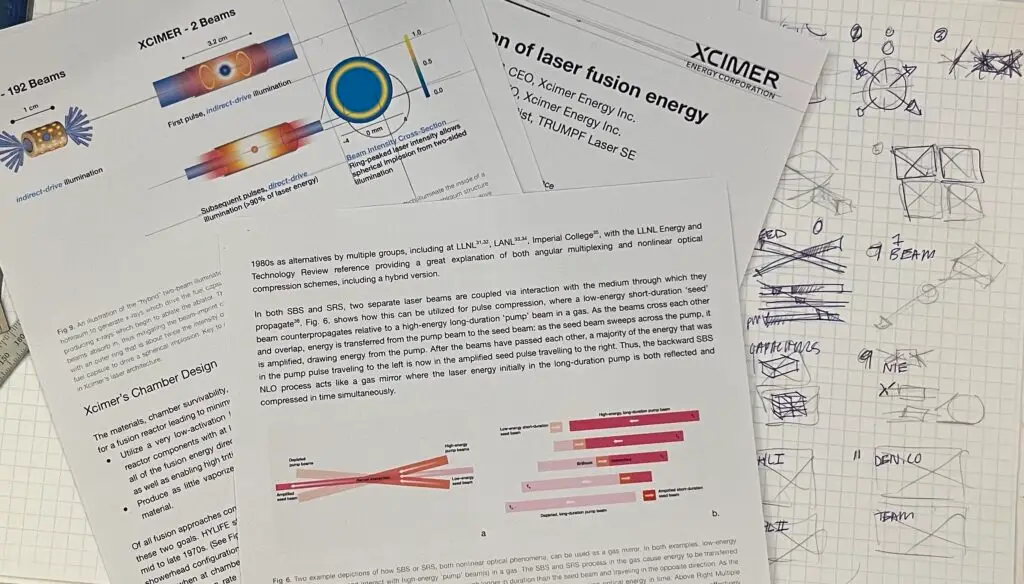
Xcimer publishes roadmap to commercialize laser-inertial fusion
Co-authored by Xcimer founders and Dr. Dirk Sutter of TRUMPF Laser SE, white paper outlines why Xcimer’s approach offers potential for significant cost advantages.
Co-authored by Xcimer founders and Dr. Dirk Sutter of TRUMPF Laser SE, white paper outlines why Xcimer’s approach offers potential for significant cost advantages.
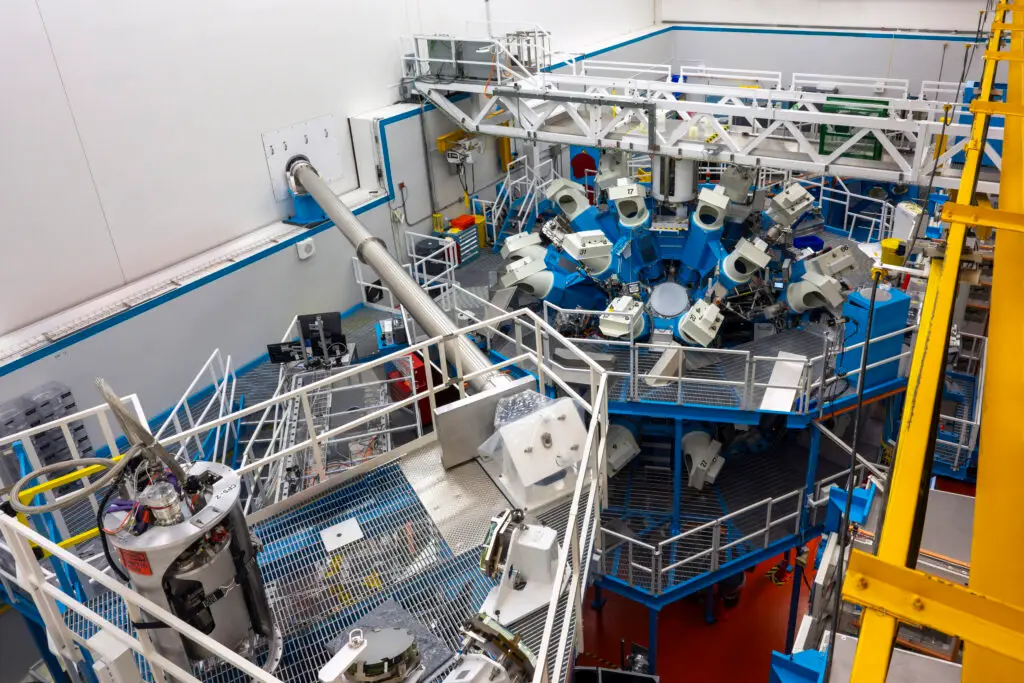
New data on hybrid hohlraums supports modeling, diagnostics, and path to scalable laser fusion systems The experiment is the latest in a growing body of Xcimer research that significantly derisks Xcimer’s approach to laser fusion – the only viable path to commercialize the only fusion approach that’s been scientifically validated to achieve net energy gain DENVER, CO — MARCH 18, 2026 — Xcimer Energy today announced that it completed experimental shots at the University of Rochester’s Laboratory for Laser Energetics, accelerating the company’s goal of commercializing laser fusion. Scientists and engineers from Xcimer and partnering institutions conducted an experiment at the OMEGA Laser Facility as part of a National Laser Users’ Facility campaign. The experiment focused on externally driven halfraums (half-hohlraums) as part of early validation of Xcimer’s two-beam approach to inertial fusion energy. Scientists and engineers from Xcimer and partnering institutions conducted an experiment last month at the OMEGA Laser Facility as part of a National Laser Users’ Facility (NLUF) campaign. NLUF is a merit-based user program supported by the Department of Energy National Nuclear Security Administration, providing academic and industrial scientists and students with access to the world-class Omega Laser Facility for basic research. The experiment focused on externally driven halfraums (half-hohlraums) as part of early validation of Xcimer’s two-beam approach to inertial fusion energy. OMEGA cannot replicate Xcimer’s full target–laser architecture, as the facility does not support the beam shaping capabilities or F-numbers required for the final design. Instead, beams were intentionally repointed onto the outer baffles of a halfraum configuration to mimic the laser–target coupling conditions Xcimer is actively designing and modeling. Copper, gold, and lead halfraums were tested, with measurements of radiation temperature and shock velocity used to constrain the radiation-hydrodynamics models that inform Xcimer’s halfraum designs. “The goal of this campaign was to
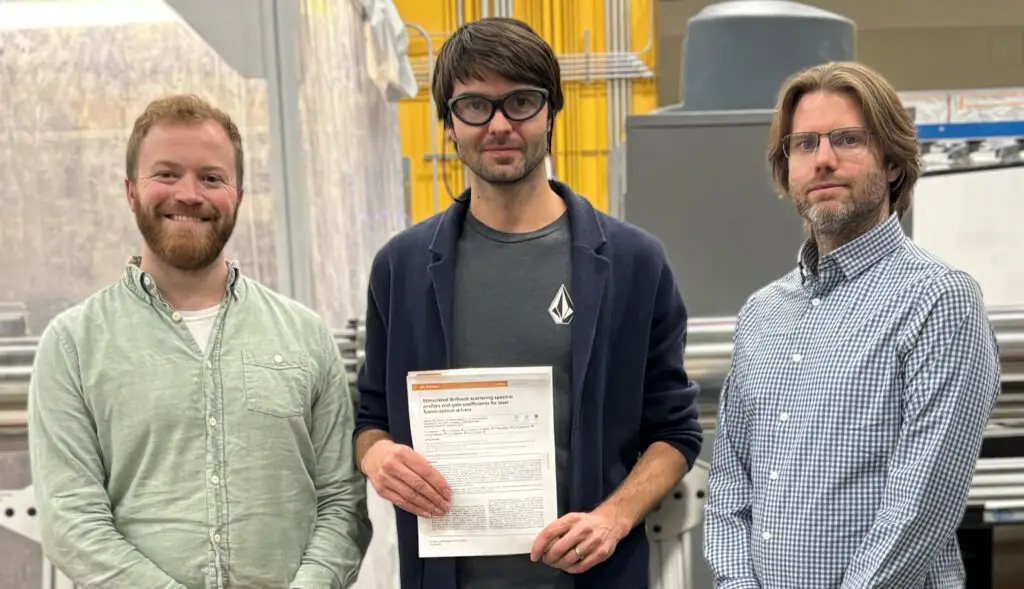
A newly published collaboration between Xcimer Energy and university researchers has overturned half a century of assumptions in nonlinear optical physics, confirming that Xcimer can remove a major bottleneck to the commercialization of laser fusion energy.